Thursday, 12 May 2016

Tackling Climate Change with Land Use Planning

Amidst all the recent discussions around resilience, the proactive role of action on climate change cannot be forgotten. And for Emily Wier and Alisa Zomer, the role played by land use planning in a city's defense against climate change is a critical one.

Above zoning ad behavioural-based policies, Wier and Zomer identify transportation planning at the single most effective tool available to cities to mitigate emissions associated with urban form. In the U.S., transportation contributes to nearly one third of carbon emissions and up to more than 50% of all emissions in some cities. Unfortunately while many cities are reducing their carbon emissions, transport-related emissions continue to increase in many cities. Weir and Zomer identify provision of a rail system, commuting distances, connectivity of transit options and a planned mix of commercial and residential development as contributing factors in a city's total transport emissions. Transport planning needs to be addressed on two fronts. The first is through promotion of alternative modes of transport through the provision of public transport to reduce the reliance on private motor vehicles. Secondly, by reducing the physical distance required for residents to commute through smart land use planning. 

The article highlights a number of methods that can be utilised to help achieve better land use planning to reduce carbon emissions. These include:

* Provision of bicycle lanes
* Electric vehicle charging stations
* Bike and car sharing programs
* Zoning to encourage housing and jobs in close proximity
* Setting clear goals and tracking progress toward these
* Linking policies to mitigation measures
* Making data transparent and available to the public

Macquarie Park Station
Source: Ing, D 2010, 'Sydney-Macquarie Park: planes, trains and buses', Blog: Distractions, Reflections, 31 July 2010, accessed 12 May 2016, <http://daviding.com/blog/index.php/archive/yyz-yvr-sydney-macquarie-park-planes-trains-and-buses/>.

Thinking all the way back to Tone Wheeler's lecture in week 2, all of Sydney's smart solutions and climate change action plans will be useless if we don't first tackle the serious problem of poor land use planning inherent in rapid urban sprawl. Very little of the new suburbs being created in Sydney's far west are supporting the principles of sustainable transport plans listed above. They are not providing public transport infrastructure or bicycle lanes nor are they accommodating a variety of uses to allow job opportunities nearby the residential development. No matter how many "zero-carbon" buildings we build, emissions associated with our transport is only growing and the land use planning solutions required to put an end to this need to be implemented fast. 

Source: Wier, E & Zomer, A 2016, 'Land Use Planning: The Critical Part of Climate Action Plans that Most Cities Miss', The Nature of Cities, 13 March 2016, accessed 12 May 2016, <http://www.thenatureofcities.com/2016/03/13/land-use-planning-the-critical-part-of-climate-action-plans-that-most-cities-miss/>.

Sunday, 8 May 2016

Living Walls


Green infrastructure is such an essential part of sustainable urbanism, reducing CO2 levels, improving air quality, providing locally-sourced foods and improving physical and psychological wellbeing. But green roofs are not the only possibility for providing green infrastructure in urban environments, more and more we see green appearing on the walls of our buildings. Not only this, but green infrastructure does not need to exist exclusively in our external environments - we spend almost all our time inside so indoor plants present far greater potential for reducing internal carbon dioxide levels, increasing productivity at work, and the close proximity allows us to touch and smell  and feel more connected to nature when indoors, promoting good health and positive feelings. 

That is why this product which appeared on my newsfeed this week was a particularly exciting find.

Source: Verde Vertical 2015, Plug & Plant, accessed 8 May, <https://www.youtube.com/watch?v=lmOVa5Mq9Z8>.

This new design by Vertical Green combines living walls with smart technology to deliver an extremely simple indoor planting system that can be used by anyone anywhere. Not only is the system incredibly easy to install at whatever scale is desired by the user, but requires minimal maintenance which is one of the biggest issues for green walls today both limiting successful outcomes and causing significant financial costs. This system monitors moisture, light levels and temperature and using a smart data collection and sharing technology, sends this information to an application on the user's smartphone so they can monitor levels and ensure conditions are appropriate for the plants. This not only enables users with next to no understanding of growing plants to grow their own indoor plants (on walls, saving space no less!) but also reminds the user to take care of the plants as required ensuring successful growth. One of the later images shown in the video of a woman picking a sprig of herbs direct from her vertical green to add straight to her cooking really sums up for me the brilliant possibilities of this system. Imagine people who live in apartments being able to pick ingredients as local as they come without even having to leave the kitchen - this is the future of sustainable urban environments. 


Thursday, 5 May 2016

Green Roofs

With green infrastructure the topic of this week's discussion, it's fitting that France has just passed a new law mandating all new rooftops to be topped with plants or solar panels. In an article releasing this news, sustainable food production and consumption advocacy group, Eat Local Grown (2016) relays the many benefits of green roofs. From passive thermal control, reducing heating and cooling energy demands, to stormwater control and habitat provision for native birds, green roofs are a comprehensive sustainable solution for urban environments. French environmental activists were advocating for a green roofing law to be passed however the inclusion of solar panels enables versatility and selectivity for the end user. This law was passed seven years ago in Toronto for all new industrial and residential buildings.

Image: Eat Local Grown 2016, France Declares All New Rooftops Must Be Topped With Plants Or Solar Panels, accessed 5 May 2016, <http://eatlocalgrown.com/article/14358-france-rooftops-plants-or-solar.html>.

Green roofs are a relatively inexpensive solution to the urban heat island effect, provision of open green space, locally grown food and are aesthetically pleasing to the eye in addition to improving air quality and reducing heating and cooling energy demand in buildings. 

With other countries catching onto the many benefits of green roofs, now is the time for Australia to enhance its own green infrastructure and realise the economic, social and environmental benefits that come with it. The study of Biophilia, human beings innate connection with nature, is now strongly embraced in the discourse of the sustainable built environment and there is abundant evidence that a visual connection with plants improves physical and mental wellbeing. So, in addition to all of the above, not only does greenery make people generally feel good, it actually contributes to increased recovery times and improves health. There is no longer an excuse to be wasting perfectly good roof space and more and more as we find better alternatives for vertical planting, there will be no excuse for wasting facades. Can we transform our buildings and eventually our cities and grow back the greenery destroyed in their construction? It's time we bring new meaning to the term 'urban jungle'.

ADDIT:
But maybe a greener future in our cities isn't as far away for Sydney as we think. This week, while working on a project in Penrith City Council area, I was scrolling through their DCP and was excited to come across a two-page section after their landscaping requirements promoting installment of green roofs and roof gardens. This section provided basic technical information to assist developers in the installation of green roofs as well as a comprehensive list and explanation on the many benefits offered by green roofs. The inclusion of this section in the DCP will surely encourage developers to consider green roofs or roof gardens as a landscaping option. Here's hoping that many other local councils are also advocating green roofs in their DCP's!

Source: Penrith City Council 2014, Development Control Plan

Monday, 2 May 2016

Urban Heat Island

Tonight, in a lecture on Urban Microclimate, Jonathan Fox expressed the concept of Urban Heat Island to us as an equation. In his explanation, Jonathan put forth the very interesting suggestion of a relationship between Urban Heat Island and the ageing population. Whilst my mind immediately made the link that significant climatic differentiation in urban areas was particularly dangerous for the elderly who are particularly susceptible to the heat, Jonathan went on to explain that the elderly, being more highly affected by the heat, are more reliant on mechanical heating and cooling and thus likely contributing to the heat island effect even more.
The contribution of mechanical heating and cooling to the urban heat island was illustrated in a graph which highlighted HVAC use as the perpetrator of 40% of our total energy usage.

The close but not identical nature of my first thought as compared to Jonathan’s explanation got me thinking further. Urban Heat Island is not an equation. It is a cycle. This means that the tools we use to mitigate the symptoms** of Urban Heat Island in fact contribute to and worsen the problem. This is not good. As our surroundings get hotter, more stuffy and more polluted, we rely on air conditioning more and more to improve the temperature, flow and quality of the air inside our buildings. Unfortunately, air-conditioning units emit CO2 and heat to the air immediately outside our buildings, increasing our reliance upon them. Hot and dirty city air not only makes us uncomfortable, it makes us sick. Obviously the best defence against urban heat island is the incorporation of green surfaces in our cities.


Chua, G & Hadley, E 2014, 'Sydney tower named world's 'Best Tall Building' by CTBUH', Architecture & Design, November 2014, accessed 2 May 2016, <http://www.architectureanddesign.com.au/news/one-central-park-sydney-named-the-world-s-best-tal>.

Hopefully this is just the beginning and we see our buildings start to move from the now very overused and rarely accurate term ‘green’ to a more literal interpretation, physically covered in greenery. Unfortunately, introducing greenery can only come slowly and it has limitations. More immediately, we need to stop the everyday air-conditioner. There are so many alternatives out there now. Evaporative cooling, trigeneration, chilled beams. Many examples of passive thermal design in which no active cooling system is required at all sans for maybe a simple fan.

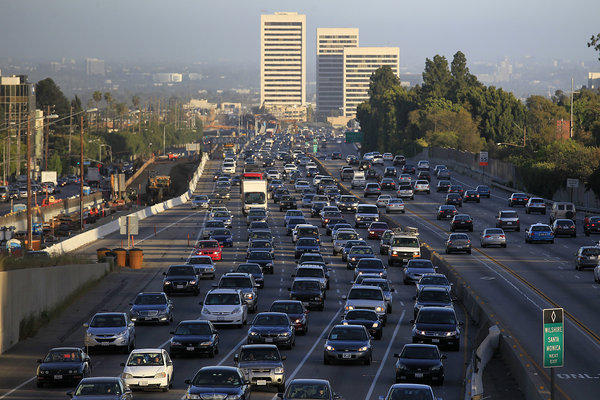
Unfortunately HVAC is not our only heat source in the city. And a big one is producing even more heat and pollution and odorous fumes. I’m sure we’ve all had the experience of jumping out of plane in a foreign city to be overwhelmed (and sickened) by the city smell. Despite travelling to some pretty dense parts of Asia, I remember this most vividly upon arrival in Los Angeles - one of the most car-dependent cities in the world. The fumes and heat generated by all that traffic was unbearable.

Groves, M 2013 'Elon Musk hates 405 Freeway traffic, offers money to speed widening', Los Angeles Times, 25 April 2013, accessed 2 May 2016, <http://articles.latimes.com/2013/apr/25/local/la-me-ln-elon-musk-405-freeway-20130425>.

Interestingly enough, the 2013 article written by Martha Groves from which this image was grabbed discusses the need for further road-widening due to major traffic problems in LA. Unfortunately it seems LA is stuck in its own cycle - it has been developed so entirely around cars that residents rely totally on cars and thus, road infrastructure needs to further developed, further cutting out the place for public transport within their system.

Phasing out cars from our cities would be hugely beneficial to mitigating the urban heat island due to its triple-fold outcome. Firstly, in that the impact of a significant generator of heat, air pollutants and greenhouse gases would be lessened. Secondly, moving people outside reduces their dependence on a controlled, air-conditioned environment and we would undoubtedly see behavioural change within our buildings as an outcome. And finally, that there would be less need for roads and thus smaller surface area of a particularly high-heat emitting surface.

Thursday, 28 April 2016

Controlling Carbon Emissions

Following the 21st annual Conference of Parties held in Paris in December last year, an article has recently been released by the World Bank sharing the views of leaders of countries, cities and big business alike on putting a price on carbon. This reflects a world-wide agreements by countries to do more and a shifting focus to businesses to own their role in the global warming crisis.
In this article, we see political leaders from right across the globe including developing countries such as Ethiopia and Mexico voice their reflections on the Paris Agreement and the inevitability of implementing (or for some increasing) a tax on carbon to combat carbon emissions.
Why is it that these developing countries, with much greater concerns than we have in the first world, are taking the necessary steps to combat global warming while Australia is still sitting on the fence and not pulling our own act together on this issue?
Is it because, as a country with a small population, we have a relatively minor contribution to global greenhouse gas emissions and thus think our impact is significant enough to warrant action? Or that we should be exempt? Is it because we still don't believe in climate change? Or is it because we're so strongly dominated by business that we let them run the show and are so concerned for their electoral vote that we refuse to force them to be accountable for their actions?
Maybe carbon tax is not the answer.
As a coach long before I ever studied the Built Environment or Sustainability, I’ve had a lot of experience in understanding what motivates people. One of the most important principles I’ve learnt in training people to do the right thing, is that incentives are a far more powerful motive than punishment. This is a well-known concept for trainers.
I cannot see, then, why this wouldn’t translate into business. Surely businesses, which are run by people, are far more driven to do the right thing when motivated by incentives rather than punishment. That is why I do not believe the Carbon Tax to be the answer. I do not believe it’s entirely without its place, in fact, it may be essential. But it is not comprehensive. Businesses need to be incentivised to learn to do the right thing. Instead of only taxing them heavily when they do the wrong thing (i.e. emit excessive levels of CO2), we should reward them when they do the right thing. We should promote sustainable energy initiatives of companies with an incentive program.
The biggest argument against the Carbon tax in Australia is the secondary impacts it has upon citizens. Where the cost of energy to users was increased significantly to offset the cost to companies. An incentive program would not present the same issues to households. 
This seems to be realised by the president of Mexico, where clean energy certificates were introduced in conjunction with carbon taxing to incentivise businesses to do the right thing.
Another extremely important viewpoint realised in this article is that of Mayor Eduardo Paes of Rio de Janiero who puts the responsibilities for climate change action back on the cities as the source of 70% of emissions. Rather than tackling climate change at the federal level, reducing the issue to a much more manageable level allows greenhouse gas emissions to be tackled at the source and not generalised, accommodating and recognising the unique attributes of the city and its inhabitants that contribute to the issue. Below is pictured a Global Climate March event in Rio de Janiero on the 29th November 2015, one of the thousands held in the lead up to the 2015 United Nations Climate Chnage Conference in Paris.

Image: Adelaide Silva, M 2015, Rio de Janeiro, Brazil, 29 November 2015, accessed from Alamy on 28 April 2016, <http://www.alamy.com/stock-photo-rio-de-janeiro-brazil-29th-november-2015-global-climate-march-event-90641797.html>.

Reference:  The World Bank 2016, 'Leaders Set Landmark Global Goals for Pricing Carbon Pollution', The World Bank, 21 April 2016, accessed 28 April 2016, <http://www.worldbank.org/en/news/press-release/2016/04/21/leaders-set-landmark-global-goals-for-pricing-carbon-pollution>.

Thursday, 21 April 2016

Proactive v Reactive Resilience

As highlighted by The Project's Waleed Aly in a recent piece attacking Herald Sun journalist, Andrew Bolt for his ignorance, climate change can no longer be dismissed as a possibility, opinion or even a theory.

Source: The Climate Council 2016, The Bolt Retort, Facebook page, 7 April 2016, accessed 21 April 2016, <https://www.facebook.com/climatecouncil/videos/784838048319457/>.

We can no longer ignore climate change. Surely there is no way our political leaders can continue to refute the evidence. And the time to act is now. We talk about resilience theory more and more. It is our cities' ability to respond to the effects of climate change. But simply recovering from disturbances caused by climate change is a reactive response. Nina-Marie Lister (2016) discusses a transition to Proactive Resilience.

Lister describes how despite more than two decades of research, little has been done in the development of policy strategies and design applications for resilience. While extreme weather events including New York's Superstorm Sandy in 2011 and Toronto's ice storm in 2013 has prompted resilience strategies, these have been reactive and rarely continued on into long-term plans once the crisis has subsided. A proactive response involves coordinated urban planning and design for resilience. Resilience must be built into the design of our cities. So what does this look like?

Well, as urbanisation places increasing pressure on our cities, the quality of the infrastructure being built to support it is diminishing. In order for our cities to be resilient, it is most important to never lose sight of the quality of urban planning and built form. After this most essential factor, Lister discusses three approaches to be incorporated in our cities and in our buildings when designing for resilience.

1. Embracing dynamic system change in favour of stability, certainty and predictability. Dynamicity describes a quality which we more familiarly refer to as 'adaptability'.

Fig 3
Image: Non linear habitat management: Dynamic uses proposed for Massachussets Military Reservation at various stages of ecoloical succession (Lister 2016)

2. Reintegration of landscape with planning and architecture incorporating coastal management policieis and flood management plans

Fig 4 copy
Image: Toronto's Wet Weather Master Plan, drawn in section to depict implication on landscape infrastructures (Lister 2016).

3. Transformative capacity i.e. shifting our perception of acceptable norms our environments need to bounce back to by building in the ability to change with conditions.

Fig 5
Image: Resilience visualised as a function of the adaptive cycle (Lister 2016)

Resilience is an interesting new approach to sustainability and certainly an important consideration not just because it is becoming increasingly relevant with increased frequency and severity of natural disasters but because of its place in responding to war and resource scarcity and financial crises. However, a focus on resilience can sometimes cause a tendency for us to be reactive in our response to sustainability. Resilience-thinking needs to be directed to a proactive approach which equips our cities to avoid the impacts of crisis rather than simply being adequately equipped to recover from crises after they have struck.

Source: Lister, N 2016, 'From Reactive to Proactive Resilience: Designing the New Sustainability', The Nature of Cities, 15 March 2016, accessed 22 April 2016, <http://www.thenatureofcities.com/2016/03/15/from-reactive-to-proactive-resilience-designing-the-new-sustainability/>.


Sunday, 17 April 2016

Sustainability and Resilience

In this week’s reading, Charles Redman discusses whether sustainability and resilience, which have started to become interchangeable terms, should be combined or remain distinct. Whilst it has become commonplace for researchers to want to combine Sustainability science and resilience theory, Redman argues that although he at first had the same inclination, “fundamental assumptions within each approach differed and even contradicted each other” (Redman 2012).

Redman’s  purpose in making this argument is that by treating resilience and sustainability separately, the distinctiveness of these approaches may be built upon and then we can focus on how their shared objectives may be achieved. Redman likens resilience and sustainability to adaptation and transformation. While resilience is the “capacity of a system to experience shocks while retaining function, structure, feedback capabilities, and therefore identity”, sustainability science seeks to address the “major challenges facing society” while ensuring the wellbeing of humans and the planet (Redman 2012).

Whilst Redman argues for the separation of these approaches and many other academics argue for their combination, I see two distinct terms that not only have significant overlap but which are dependent on each other. While sustainability is an approach to present day challenges without compromising the needs of the future, resilience is the response after the challenge, the urban environment’s inherent ability to bounce back. Whilst these two things can exist as completely separate characteristics, they are unlikely to. A sustainable response to a city responding to crisis would not only be to rebuild itself but to rebuild itself to resist the effects of a repetition of that crisis in the future – to meet the needs of the future generation. Therefore, while maybe not essential, a sustainable city is likely to be, should be, resilient. What about a resilient city? Well, a city that can comfortably bounce back from a crisis is a city that can support itself and its people for the long-term and should therefore be sustainable. But hold up. While this meets our most basic definition of ‘sustainability’ it doesn’t necessarily satisfy the triple-bottom-line ‘sustainability approach’. A resilient city which supports the economy and health and society to bounce back after crisis, cannot be sustainable if it has completely destroyed the environment in the process.

This discussion of resilience vs sustainability reminded me of the self-recycling video I wrote about in my post the other day and a website I discovered shortly after this: http://newplasticseconomy.org/


The New Plastics Economy is a movement driven by the environmental impacts of plastic disposal from the traditional linear economy of make à take à dispose towards a new “circular economy” in which plastics are reused over and over again. Whilst this idea is born out of the ‘sustainability approach’ to tackle a current issue, it has ramifications on the resilience of the plastics economy. Say the raw resource suddenly ran out. The current linear plastics economy would not be able to bounce back from this. It relies on raw material input to keep the system going. The circular system on the other hand, is a more resilient one in which a component (raw material) could be taken out and the system would continue to operate. Say New Plastic Economy’s resolution to the plastic problem was self-recycling as seen in the video from my last post. This system which touches on some sustainability factors such as lower energy emissions but does not satisfy others in its decreased efficiency, is even more resilient as it has a multitude of individual operations functioning so no matter which one is disrupted, it will not affect the continued functioning of any other machine or the system as a whole.  

Source: Redman, C 2012, ‘Should sustainability and resilience be combined or remain distinct pursuits?’, Ecology & Society, vol. 19 no. 2, DOI: 10.5751/ES-06390-190237, pp. 398-405.

Source: Ellen Macarthur Foundation 2016, The New Plastics Economy, accessed 15 April 2016, <http://newplasticseconomy.org/>.